With Pokémon Sun and Moon, Game Freak are giving a new twist to a lot of earlier Pokémon, using older designs as the basis for new ideas.
This isn’t the first time this has happened – Pokémon’s history is filled with times that designs have been scrapped, reworked, or simply put to one side, before being resurrected for later games. In some rare cases, Pokémon have even been scrapped entirely, quite far into development, but have left behind traces in the game’s programming.
Today we are exploring some of the weirdest and most wonderful early designs for Pokémon that were ultimately scrapped or redesigned at a later point. These are 15 Scrapped Pokémon Designs That Were Reworked Entirely.
15. Dolly the Sheep

The second generation of Pokémon saw the introduction of Mareep, a little electric-type sheep Pokémon. Plenty of Pokéfans suspect that this is a not-so-subtle reference to Do Androids Dream of Electric Sheep, a story by science fiction author Phillip K Dick which was the inspiration for the movie Blade Runner.
Mareep wasn’t the first sheep Pokémon that Game Freak came up with, though – original Pokémon art director Ken Sugmori has spoken publicly about a design that was created for Pokémon Red and Blue which was based on Dolly the Sheep, the world’s first cloned mammal. Dolly was big news at around the time the game was being worked on, so it’s no wonder the team wanted to pay homage to the world’s most famous farm animal.
Ultimately, according to Sugimori, the sheep Pokémon they’d created was abandoned, on the grounds that the idea might prove “too controversial”. Considering how many parent groups, religious leaders, and other special interest groups objected to Pokémon when it was finally released, dropping Dolly didn’t seem to help too much.
Whatever design the team came up with for their clone Pokémon, it’s never been released to the general public, so fans can only speculate about what they might have seen.
14. MissingNo

The grand poohbah of Pokémon mysteries, fans have come up with plenty of theories about MissingNo over the years. While the entire story behind the glitch Pokémon isn’t quite clear, it’s been agreed that MissingNo is what remains of a Pokémon from an earlier version of the game which was ultimately scrapped.
The finished version of the original Pokémon games contain 151 Pokémon, but the games were originally intended to have 190 creatures, and there exists data within the game for an additional 39 Pokémon which were never fully programmed in. When a MissingNo of various forms appears in the original Pokémon games, it’s because the game is trying to access data for a Pokémon that doesn’t exist within the game.
Nine of the 39 free slots within the game have been programmed with unique Pokémon cries, suggesting that there were plans for additional Pokémon that were never completely programmed into the game. What’s more, some forms of MissingNo are Bird-type Pokémon – this type is believed to be an earlier version of the Flying-type. This has led to more speculation as fans suggest that MissingNo is what remains of at least one scrapped Pokémon design, which may have been an additional legendary bird.
13. Shellos

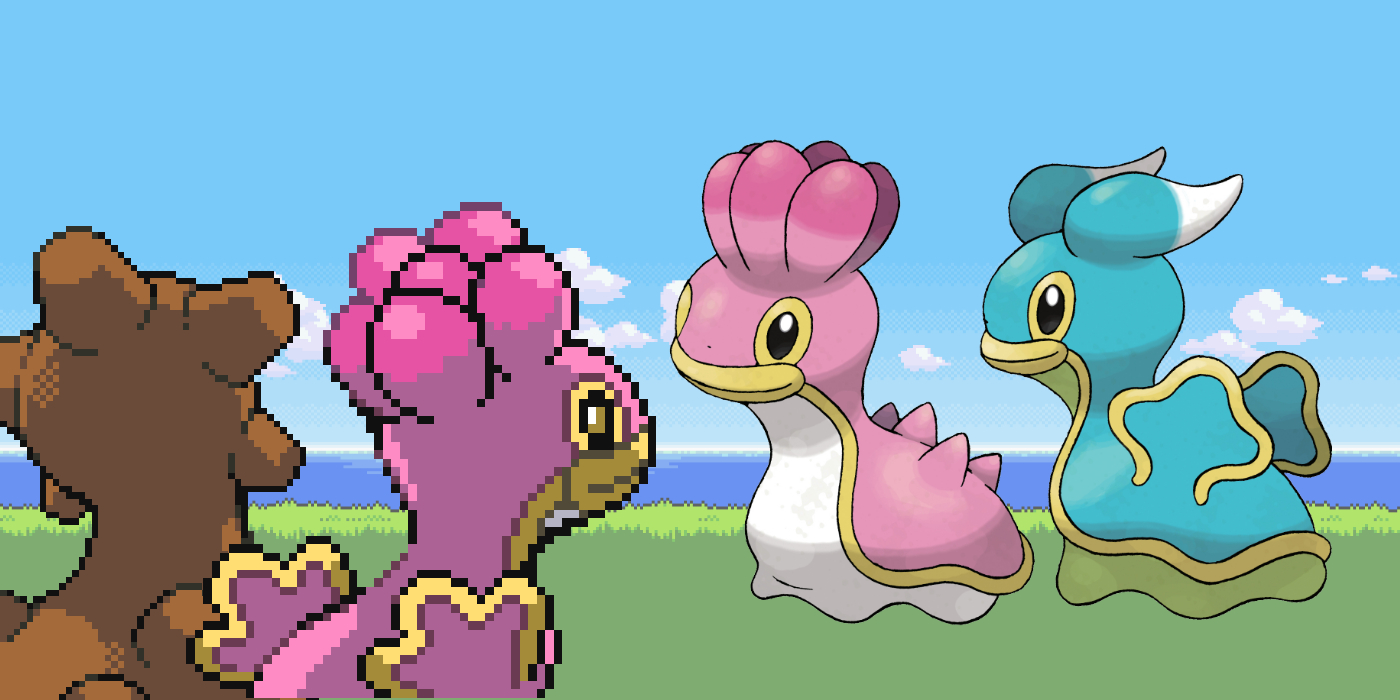
Shellos is a fourth-generation Pokémon, appearing for the first time in Pokémon Diamond and Pearl, and being notable for having different sprite designs depending on whether the Pokémon is caught on the east or west coast of the game’s map.
This wasn’t the first time Shellos was programmed into a Pokémon game, though – sprites for the Pokémon have also been found within the earlier games, Ruby and Sapphire.
This, fans speculate, suggests that Game Freak originally intended the Pokémon to appear in Ruby and Sapphire, before ultimately deciding to scrap their inclusion. A few years later, when working on designs for Diamond and Pearl, Game Freak returned to Shellos and elected to include it within the new games.
This kind of thing happens fairly regularly with Pokémon games – it’s believed that the 39 empty Pokémon slots within Red and Blue, which cause MissingNo glitches, are present because many Pokémon from Gold and Silver were originally intended to appear within the first games in the series.
12. Tirtouga

Tirtouga is a Pokémon from the fifth generation of games, appearing first in Pokémon Black and White. The creature may have roots far earlier in the games, though, if fan speculation is to be believed.
A piece of promotional artwork from during the development period for Pokémon Gold and Silver shows off a creature that doesn’t appear in the final game. The unnamed turtle Pokémon has never been given any specific description or name, but fans have noted that it looks very similar to Tirtouga, fueling speculation that the earlier scrapped design was later reworked into a new creature, over a decade after it was originally designed.
The fifth generation of Pokémon games feature several sly references to earlier games. Fans have also noted that the Pokémon Munna, which is pink with a floral pattern, matches a line of NPC text from the original games wherein a Pokémon trainer wishes that there were pink, floral Pokémon in the area.
11. Latiaziken

It’s clear from early art documents for Pokémon Ruby and Sapphire that some of the Pokémon designs for the game went through substantial changes quite late into the game’s development.
In one case, Game Freak took a single Pokémon design and sliced it up, creating three new creatures out of a single piece of concept art. Commonly known as ‘Latiaziken’ by fans, the artwork shows a trainer riding on top of a bird Pokémon with arms and legs.
This design wouldn’t appear in the finished game – instead, the arms and legs would be taken off and given to Blaziken, the final evolution of Torchic, the game’s fire-type starter. The Pokémon’s body became the basis for Latias and Latios, two legendary Pokémon that are almost identical except for their color scheme.
It’s fun to see what ideas Game Freak were tossing around while working on Ruby and Sapphire. Latiaziken might not have made it into a game, but sometimes a single design can be stretched further than originally intended.
10. Kurusu

Back when Pokémon Gold and Silver were in development, fans of the original games were hungry for any new information they could find on the next titles in the series. Something about the idea of hunting out various creatures across a game world is a compelling idea, which many fans took outside of the game as they looked for new designs in every communication from Nintendo.
Kurusu was originally revealed during this period, as Game Freak shared some of its concept art and beta screenshots for Gold and Silver with the public. Later, a playable demo of the new game was created, which featured Kurusu as the water-type starter for players.
Kurusu is vaguely based on a seal, but its featureless design ultimately didn’t win it many fans, and it was eventually replaced by Totodile. Some fans speculate that Game Freak might have revisited the design when creating the Pokémon Spheal, but this is unconfirmed.
9. Honoguma

Revealed at the same time as Kurusu, Honoguma was the original design for the fire-type starter in Gold and Silver. Its name (which has never been officially confirmed by Nintendo but which is taken as accurate by most fans) combines the words hono, which is Japanese for ‘flame’, and kuma, the Japanese word for ‘bear’. Thus fans have speculated that this might have been intended as some form of fire-type bear Pokémon.
In practice, of course, the design does look very similar to a fiery Pikachu. Rumors about new forms of Pikachu dogged much of the development period for Gold and Silver, and with other Pokémon such as Marill and Pichu both resembling the franchise mascot, it makes sense that Game Freak ultimately went in a different direction for the fire-type starter in the games.
Some fans speculate that Honoguma might have ultimately been reworked to become Teddiursa, the small bear Pokémon, but aside from the scrapped Pokémon’s name, there’s not much linking the two creatures together.
8. Happa

The final original starter design from the Gold and Silver alpha game build, Happa ultimately changed the least over the course of the games’ development. A single-eyed lump of green with a leaf on its head, Happa (whose name means ‘leaf’ in Japanese) looks vaguely similar to a large fungus or single-celled organism.
Unlike Kurusu and Honoguma who were entirely replaced with new Pokémon designs, at some point in development, Happa received a major overhaul, becoming a different Pokémon that still bears similarity to its earlier design. Chikorita differs from Happa thanks to its fully formed body with legs, and Chikorita’s evolved form shows that the creature’s design is more inspired by the long-necked dinosaur, the diplodocus, than any microscopic life form.
If Happa is actually based on a micro-organism rather than anything else, Game Freak eventually returned to this idea with Solosis, Duosion, and Reuniclus in Pokémon Black and White.
7. Gorillaimo

The original Pokémon games had a very long development period, taking several years to go from initial concept to finished releases. Part of the problem was that Satoshi Tajiri, the man who created the initial idea for the series, had a difficult time explaining what Pokémon would be about to others, including the executives of Nintendo.
The concept of capturing, training, and battling a collection of monsters sounded both ambitious and difficult to sell, so Tajiri was required to pitch the game to Nintendo several times before he could get their approval for the game. To help convey the concept, Game Freak produced a lot of concept art with trainers battling or collecting different Pokémon – this was all done long before the game’s actual monsters were developed, so plenty of them have never seen the light of day.
One particularly interesting piece of concept art shows a dinosaur battling against a giant ape. This could be a reference to King Kong fighting Godzilla, or it could be a sly wink to Donkey Kong. Either way, fans speculate that the design may have been later reworked to create Slaking, a third-generation Pokémon based on an ape.
6. Godzillante

The Godzilla-based Pokémon from early concept art for the initial games has more links to other designs throughout the Pokémon series.
In the very early days of development, a lot of the Pokémon designs revolved around dragons, dinosaurs, and other large, scaly monsters – it wasn’t until development of the games got further that softer, cuter creatures were introduced to the series. Godzillante was a typical design for the earliest period of development, but while its design didn’t appear in the first generation of Pokémon games, it has subsequently been reworked in subsequent games.
Notably, Godzillante looks very similar to Tyranitar, a Pokémon which was introduced in Pokémon Gold and Silver, the second generation of games. It’s possible that this was one design which was considered for the original games, but ultimately shelved until the sequels.
Godzillante is shown breathing fire, which is likely a reference to Godzilla’s atomic breath – at this point, the game was not developed enough to include different elemental types.