The horror anthology comic book is one of the most important cornerstones of both modern comics and modern horror. While their expressionistic style influenced a whole generation of artists, and their scripts stand now as masterworks of compressed storytelling, the full range of influence that the horror comics started by EC Comics had is often unappreciated.
While most comics struggled to slip the "for kids" stigma, EC Comics were marketed squarely to adults in the 1940s and '50s (so squarely that they ended up getting themselves and anything remotely like them banned by the Comic Code Authority for 20 years; there is such a thing as doing your job too well). The likes of Tales From The Crypt and Vault Of Horror told stories about average blue collar and suburban people caught up in the inexplicable, when most horror literature of the time was still focused on gothic castles, old world curses, and the outlandish trappings of pulp. This refocusing of horror's aim (along with the work of writers like Richard Matheson and Charles Beaumont) paved the way for everything from The Twilight Zone to the novels of Stephen King. In doing so, EC and its rivals and descendants employed some of the best artists and authors of its era and influenced some of the greatest writers of ours.
Here are the The 15 Best Horror Anthology Comics Of All Time.
15. The Sleepwalker (Tales From The Darkside #1)

Joe Hill and Gabriel Rodriguez are one of the best teams working in comics right now. Period. The duo is responsible for Locke & Key, which basically means they could take any number of risks, and we would still like to know what they're up to next. When Joe Hill's attempted revival of Tales From The Darkside didn't make it to series on television, Hill and Rodriguez reworked some of the scripts into comic book form, the first of which was just released from IDW.
The story is about a young man whose negligence causes an accident, and now finds himself putting anyone he comes into contact with asleep. It's solid Twilight Zone stuff, and Rodriguez's brilliant layouts and expressive character work are as great as ever. It's only the first issue, and with this as its promising first story, we're sure the series will find its rhythm. After all, it has a lot of legacy to draw from.
14. And All Through The House (Vault Of Horror #35)

In an odd way, "And All Through The House" has become the flagship story of the EC Comics line. In one sense it's an outlier from the publisher, with hardly a rotting, resurrected corpse or voodoo curse to be found (though it does feature an ax wielding maniac in a Santa costume). On the other hand, it's a perfect example of the EC formula wherein people are trapped by their own nastiness.
A suburban house wife decides to kill her husband on Christmas Eve. This is all well and good (for her), except that a murderer dressed as Santa Claus has just escaped the local asylum and decided to pay her a visit. If she calls the police, her own murder will be revealed, so she must simultaneously fend off the killer and cover up her crime. This being an EC comic, things do not go well.
It's an irresistible story and it's been adapted twice, once by Freddie Francis for Amicus's rather excellent Tales From The Crypt film and the second time by Robert Zemekis as one of the first episodes for the Tales From The Crypt HBO show. It's easy to see why they were interested. This story is nasty, funny and genuinely scary, like a plate of Christmas cookies laced with cyanide.
13. Father's Day (Creepshow)

One of the easiest places to see EC Comic's influence is the work of Stephen King. If comics like those from EC and writers like Matheson, Bradbury and Beaumont broke ground in focusing the horror story on working class people, as opposed to the upper class, King, without a doubt, perfected it, taking a cue from EC's lurid gore and dark humor (King was open about the influence, speaking about it in interviews as far back as Salem's Lot).
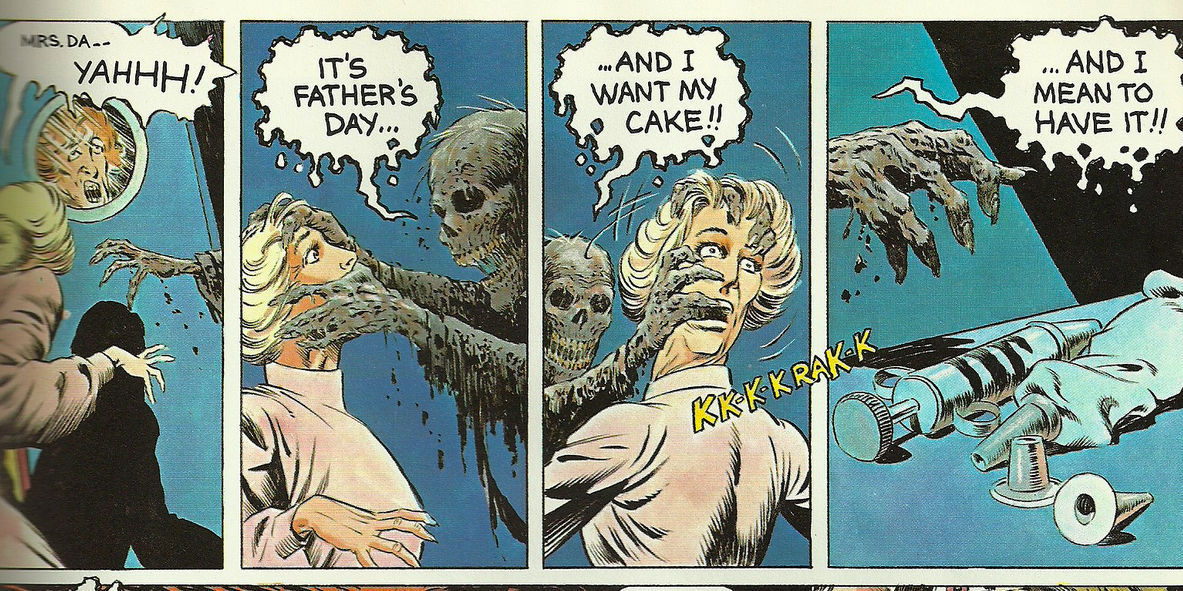
King and director George Romero paid tribute to the art form with the anthology film Creepshow, which is about as fun as movies get. After the film was released, King took the tribute a step further, hiring artist Bernie Wrightson to translate the screenplay to comics form. Wrightson did a fantastic job, faithfully reproducing the EC house style while taking advantage of the new techniques available in the 1980s. The most fun to be had in Creepshow (in either form) is probably the first segment, "Father's Day," in which a truly awful dysfunctional family comes together to celebrate the holiday, only to have a long dead patriarch crash the party with some very particular ideas about how to celebrate. The punchline is a perfect imitation of the EC style, gruesome, darkly funny and strangely fitting.
12. Daddy Lost His Head (Vault Of Horror #19)

The publishers at EC were less than careful about where their stories came from. The staff writers weren't above lifting a good story when they saw one. As a result, the reader of one of their comics could wind up with an inadvertent education in horror stories both classic and modern. Unofficial adaptations of Edgar Allen Poe, H.P. Lovecraft and Ambrose Bierce filled their pages, as well as the works of then contemporary authors.
One of the most frequently cribbed authors was Robert Bloch (author of Psycho, among others), whose instinct for the gruesome, along with his gallows sense of humor and gotcha endings, made him an irresistible fit for these types of stories. One of the best of these "adaptations" is "Daddy Lost His Head!," taken pretty obviously from the Bloch story "Sweets To The Sweet," about an abusive father whose daughter is given a voodoo doll cookie. Where the story goes from there might be fairly easy to guess from the title, but seeing how it gets there is a good deal of fun.
11. Yours Truly, Jack The Ripper (Journey Into Mystery #2)

After lying fallow for a couple of decades due to censorship, the horror anthology comic began to cautiously re-emerge. First with Warren comic's Eerie and Creepy in the mid-'60s, which, though fun and featuring some fine work (see the next entry) were also relatively tame compared to the EC stories of lore, and were never quite as iconic. After the commercial success of these titles, DC and Marvel followed suit with the likes of House Of Mystery and Vault Of Evil, titles that leaned heavily on covers with intricately drawn covers featuring skeletons, but were so tame on the inside that they made Creepy and Eerie look like Cannibal Holocaust by comparison.
Marvel's Journey Into Mystery #2 is a pretty good indication of what these titles were like. Taking another story from Bloch (credited this time!) and pretty much guaranteeing that it wasn't going to frighten anyone by the time that they were through with it. A lot of stuff from this era is fun, but there's a reason that precious little of it ended up becoming iconic.
10. Second Chances (Creepy #13)

Steve Ditko is one of the foundational figures of modern comics, responsible for some of the finest work at Marvel and a genuine iconoclast. After quitting Marvel over his artistic principles, Ditko became something of a comics ronin, drifting from place to place. It just so happened that one of those places was Warren comics, which was sniffing around the idea of starting a horror comic again, the first company to do so after the censorship debacle of the 1950s.
Which is how Ditko ended up drawing for Eerie and Creepy. It was a surprisingly neat fit, with Ditko's odd angular characters and expressionistic backgrounds, as well as his stark Objectivist morality making his work a natural fit. "Second Chance" is a typical Ditko story, as it allowed him to draw some really weird hellscapes (this is the man who invented Doctor Strange after all) and rain down hardcore punishment on just about everyone in the story.
9. Carrion Death (Shock SuspenStories #9)

Though the EC Comics covered a far range of different genres: horror, fantasy, sci fi, even fairy tales, one thing always remained consistent about the formulas, the grand majority of stories involved horrible things happening to terrible people. Since the EC stories were basically a machine for generating grim fates, the only way to really enjoy them was to make sure that the characters who were killed thoroughly deserved their deaths. Of course, that means that most (OK, pretty much all) of the characters featured in EC's stories were fairly one dimensional. But character development takes time, and the life span of an EC character was usually pretty short.
A prime example of the horrible things happening to terrible people formula is "Carrion Death," which features a psychopathic escaped prisoner who ends up handcuffed, first to a cop and then a cop's corpse, when he attempts to escape across the desert. He tries to solve his problem with the aid of some vultures. Things go poorly. "Carrion Death" was another story that ended up adapted on The Tales Of The Crypt show, starring Kyle MacLaughlin in a rare bad guy role. It modifies the ending slightly, basically turning it into the sickest Wylie Coyote gag of all time.
8. Sandman #55

Neil Gaiman's Sandman is nothing without stories. Stories nested within stories, stories that reflect other stories. Stories that conceal or reveal depending on whose telling them. The arc from Sandman that this issue comes from is a story within a larger story about a bunch of people stranded at an inn telling each other stories. So while it's difficult to find a genuine anthology comic in Gaiman's work (there are a lot of standalones, collected in trades, but the definition of anthology we're using for this article is multiple stories told within a single issue).
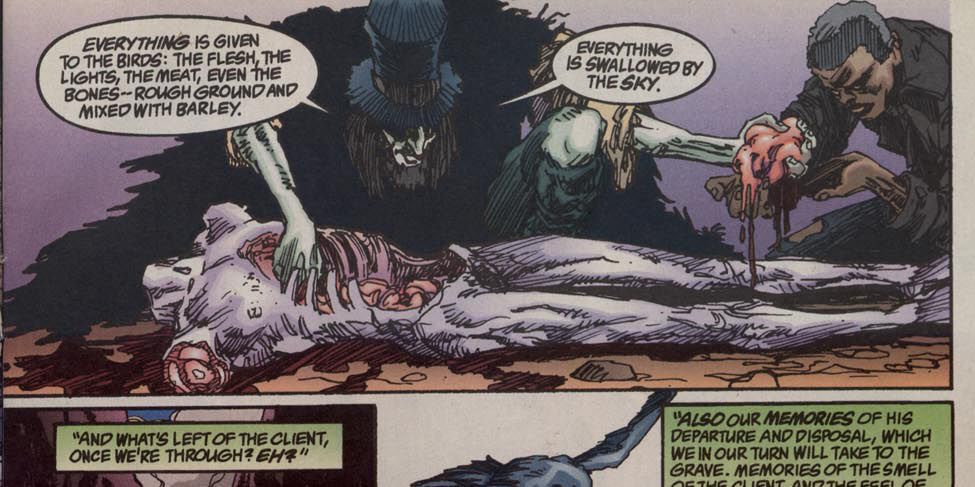
Luckily, we have Sandman #55, in which a "prentice" from a city devoted to funerals relates the story of his training as well as four stories relating to death, destruction and, this being Gaiman, another story about people telling stories (for those of you playing at home, that's a story about someone telling a story, in someone else's story, itself a substory, in a larger story). It's Gaiman at his best, a mixture of world-building, eerie tone poem and folklore. The fact that Gaiman has so thoroughly imagined even this obscure corner of his universe gives the whole fictional world a tactile feeling of reality unmatched in comics, a place you could glimpse if you just got caught in the right storm.
7. Greed (American Vampire Anthology #1)

If there's a king of modern horror comics it's Scott Snyder, with titles like Wytches, Severed and The Wake, Snyder has established himself as someone who can come up with great original horror stories on the fly. Yet his best title may still be his first. There's something about American Vampire, the richness of its imagination, the canny way it inverts standard vampire mythology, the cleverness with which Snyder's stories reflect their time periods, that not only makes the stories themselves rewarding, but practically demands that other writers come to play in the universe.
The series has already supported non-Snyder penned spinoffs but took things a step further with its own anthology collection, inviting writers like Becky Cloonan, Greg Rucka and Gail Simone to take his mythology out for a spin. Everyone does solid work. Highlights include Simone's backstory for one of the villains in "Essence Of Life" and Gabriel Ba's and Fabio Moon's rampage through a Harlem nightclub in "Last Night." But the best story has to be Cloonan's "Greed," which finds a fine corner of movie geek history for Skinner Sweet, Snyder's lead vampire, to invade.
6. Fatale #22

One of the best horror comics of the modern era is Ed Brubaker's Fatale, which uses anthology style storytelling in some interesting ways. Arguably, the entire series could be defined as an anthology, a series of self contained stories stretching over the course of the 20th century (mostly) about a mysterious young woman, the effect she has on the people she encounters, and the cult obsessed with her. One story arc takes it a step further, exploring incidents from her past one issue at a time.
But going by the rules of the column, which define an anthology comic as multiple stories in a single issue, there's only one comic from Fatale's run that really fits, and that's #22, which delves into the backstory of the malignant Bishop (both name and title), who serves as the chief villain in the series. Brubaker uses the form in an interesting way. Using the fragments of Bishop's past to create not so much discrete stories as a montage of evil that spreads and infects for almost a hundred years. Usually, the anthology is to be praised for the economy of storytelling that it encourages, but Brubaker found a way to use the anthology to create a genuinely frightening sense of scope.