


Sci-fi TV show monsters often have an alien quality to them, even when they are not literally from another planet. While the sci-fi genre is often best known for its tropes, like spaceships and scientific advances, some of the best sci-fi TV shows regularly incorporate elements from other genres, like horror and fantasy. This can give us some very creative monsters.
The term "monster" can have a loose interpretation in sci-fi. Shows regularly feature outlandish characters with a sense of humanity, while some of the best sci-fi TV show villains appear to be human while behaving like monsters. Many of the most iconic TV show monsters of all time are found in the sci-fi genre, and are as varied as any group of aliens could be.
The Invaders
The Twilight Zone

The Twilight Zone's twist endings and terrifying monsters are legendary, even though the special effects do not hold up today. One of the most common themes for the show was humans behaving like monsters, but the episode "The Invaders" still shocked everyone. The Invaders are miniature aliens who terrorize a frightened woman in her home using advanced weaponry.
The episode perfectly represented the idea that size is no guarantee of power, and this would have made the Invaders memorable on their own. However, the twist changed everything, showing that the Invaders are actually from Earth, while the woman is an alien giant. The question of who the "monster" was depended on whose perspective was being shown.
Maldis
Farscape

Maldis is arguably the most malevolent being in the entire Farscape universe. He is technically a sorcerer, but acts as a sadistic psychic vampire, feeding on the pain and suffering of those around him. While he is played by Chris Haywood in the show, Maldis has no real form and inhabits other characters, so we do not know what he truly looks like or how old he is.
Maldis appears to be impossible to kill, and though Zhaan defeats him twice, the show left the possibility open for him to return once more. The best classic episodes of Farscape usually show good triumphing in the end. Maldis' presence was usually a disturbing outlier, as he was only defeated at a great cost to Zhaan and the other characters.
Strigoi
The Strain

Vampires are usually great horror TV show monsters, but the strigoi in Guillermo del Toro's The Strain puts a disturbing new spin on the species. The Strain blends sci-fi with horror, centering on a pandemic that now feels like eerie foreshadowing to a post-2020 world. The strigoi blend the speed of vampires with the infectious capabilities of zombies, but add another twist.
Strigoi can infect their victims from further away, with a disturbing stinger-like tongue, releasing a virus that affects their genes. They may even disturb body horror fans, as another strigoi-specific feature is the skin-burrowing worms that they unleash, which often target their victims' eyes. The show spotlights their exact biology and dissection, making the strigoi memorable even when dead.
Demogorgon
Stranger Things

Stranger Things blends several genres, with the Demogorgon fitting into each one. It is visually horrifying enough for a horror show, mysterious enough for fantasy, and it works equally well as a sci-fi monster. The Demogorgon is the first monster spotlighted in a show full of disturbing beings, and while the focus has shifted to Vecna, the Demogorgon is a monstrous icon.
Stranger Things' Demogorgon is more than just a humanoid-looking monster with a multistep life cycle, as it appears to have world-changing powers too. It can move between realms, dragging victims from our world to the Upside Down to feed on them, and unlike the other "big bads" in the show, it is relentless, with no motive other than to feed.
Eve
The X-Files

The iconic 1990s sci-fi show The X-Files was famous for its monster-of-the-week format, but some of the series's monsters were scarier than others. The best episodes of The X-Files often touched on bigger world issues, like cloning and the rise of AI, and "Eve" was one of the most memorable. Each villain in "Eve" revealed more of the disturbing truth.
The Eves were a series of clones with a genetic instability, leading many of them to become murderous. The twins are presented as tragic victims at first, but develop into terrifying psychic serial killers throughout the episode as more Eves start to appear. The final shot is one of the most haunting in the show, setting up a potential sequel that never happened.
Cylons
Battlestar Galactica

The robot creations, Cylons, are some of the most fascinating sci-fi monsters of all time, as many of them believe themselves to be human. This makes them harder to spot, making their threat central to the most tense moments in Battlestar Galactica. While Number Six is the most recognizable of Battlestar Galactica's Cylon characters, Number One is the best villain.
Like many great sci-fi monsters, the Cylons are complex, and their status as human-made creations makes them even more eerie. Their story is an updated version of what is arguably the first-ever sci-fi story to be written, Mary Shelley's novel Frankenstein, in which a scientist goes too far, creating another sentient being that then turns on him.
Thanopod
Love, Death + Robots

There are very few sea monsters in sci-fi TV shows, and this is part of what makes Love, Death + Robots so memorable. The cyberpunk anthology series features several, but none are as creepy or visually grotesque as the Thanapod in the episode "Bad Travelling." Its name translates to "hell on legs," which is what it brings to the crew of an oil ship.
The crablike Thanapod is one of the most terrifying creatures in Love, Death + Robots. The looming threat, as the ship's crew must make a horrible choice between their lives and those of an innocent island community, makes the episode one of the most tense, and the scenes in which the Thanapod uses the dead crew members as puppets are true nightmare fuel.
The Smoke Monster
Lost

In a show full of unexplained happenings, the Smoke Monster in Lost is one of the most mysterious and memorable of these. When the show began, it was not clear which direction Lost would take, so the Smoke Monster represented fear and symbolism as well as the possibility of there being a real monster stalking the characters, as early as its pilot episode.
Part of what makes the Smoke Monster such a great sci-fi monster is the fact that Lost kept the viewers' interest in its true nature right up to the final season. Revealing a monster's true identity can often take away some of its power, but the Smoke Monster grew more powerful, representing a threat on every level, from physical to moral and spiritual.
The Borg
Star Trek
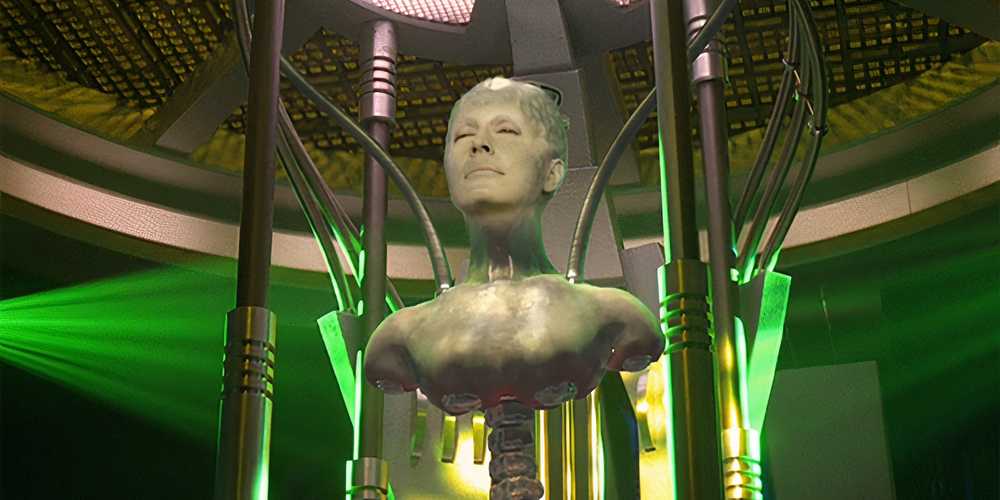
The many Star Trek series are often considered to be sci-fi shows that get better with every season, as they almost always feel fresh and new. Star Trek both introduced and updated its monsters, the best of which is the hive mind known as the Borg. Minds that are absorbed into the Borg lose their sense of individuality in pursuit of perfection as a group.
While Star Trek never fully explains the Borg, this makes it and its Borg Queen even more sinister. Its implications reflect the understandable fear of losing our identity under forced conformity, and the Borg's repeated phrase, "resistance is futile," has become a part of pop culture.
Daleks
Doctor Who

The Daleks are sci-fi TV series legends, first appearing in Doctor Who's 1963 episode, "The Daleks," and reappearing as some of the most terrifying villains in the show. While Doctor Who regularly features iconic monsters like the Weeping Angels and the Cybermen, the Daleks inspire a different kind of fear as they are based on a real-world evil.
While the Daleks' timeline is different from ours, they were created to reflect one of Earth's darkest periods, the rise of the Nazis. The sci-fi monsters are designed to look like impenetrable machines, while they regularly raise their plungers in the familiar salute.
