Most television approaches the world it creates with realism, following the rules of life as the audience knows it. However, when the creative team behind a show is feeling especially adventurous, they'll take a deep dive into the deep recesses of a character's mind and showcase their surrealistic abilities in a dream sequence. Dream sequences on television often proved cryptic insight into the mind of the character, and in longer serialized storytelling can help the character discover the truth about a situation they are in or foreshadow coming events. While an ill-intended dream sequence can ruin a TV show, a great dream sequence or hallucination can help elevate a television show to a new level of artistry.
While television dreams aren't fully accurate representations of true dreams – television dreams seeking symbolism and metaphor while real dreams simply bend the rules of logic and reality with reckless abandon and pointless chaos – the use of dreams in fiction can often communicate ideas and occurrences that words fail. The number one rule of storytelling is "Show, don't tell", and there's no better way to show what is going on inside a characters mind without "telling" than a well-placed dream sequence.
Here are 17 of the best examples for what makes a great dream sequence. Beware! Spoilers lie beneath!
17. Mr. Robot's 90's Sitcom

Mr. Robot has always played around with form, constantly shifting between reality and the altered state that exists within Elliot's head. From talking directly to the audience to spending an entire episode in a dream, Mr. Robot has always made bold, risky choices that usually pay off. No creative decision the show has made so far, however, comes close to the grandeur of the episode "eps2.4_m4ster-s1ave.aes," which took the whole USA Network back in time to the sitcoms of the '90s.
After welcoming the audience to USA's "Word Up Wednesdays", we're treated to a full 19-minute episode of the classic 90's sitcom Mr. Robot complete with laugh track, low-quality camera visuals, and even an appearance from ALF himself. While things seem happy on this sitcom family road trip, there's still hints of murder, domestic abuse, and hit-and-run committed by an Alien Life Form. Eventually, it's revealed that the sitcom was just a dreamworld that Elliot's brain constructed for itself to distract from the pain of getting brutally beaten by some freshly made enemies. While it hurts to see a beloved character get broken down, if it allows Mr. Robot to take creative risks like this, it may not be a bad thing to lay the beat down on Elliot more often.
16. Arrow - "Three Ghosts"

Oliver Queen has always been haunted by ghosts, but they've never been more visible to the audience than they were in the season two mid-season finale "Three Ghosts". Arrow's structure serves as a constant reminder of everything that Oliver Queen went through, with almost every episode showing Oliver's present day life as he becomes The Arrow alongside scenes from the five years he spent trying to survive on an island inhabited almost entirely by people who wanted him dead. In "Three Ghosts", however, worlds began to fold in on themselves and the past managed to infect Oliver's present.
After being drugged in an attempt to save his life, Oliver Queen gets Christmas Carol-ed by three figures whose death he believes himself to be responsible for. Shado, a former companion of his who ended up dying on the island; Slade Wilson, a fellow fighter from the island who is believed dead (or is he?); and Oliver's longtime friend Tommy, who died believing that Oliver was nothing more than a murderer. These drug-induced hallucinations managed to re-focus Oliver, and set the stage for a fantastic back-half of season two of Arrow.
15. Crazy-Ex Girlfriend - The "Dream Ghost" Song

Crazy Ex-Girlfriend loves nothing more than tearing down convention and expectation. This is a show whose very own theme song points out that the title Crazy-Ex Girlfriend is a "sexist term". So when it came time for Rebecca Bunch to have one of her many mental breakdowns, the show managed to not only use the tried-and-true dream sequence to help Rebecca reach an epiphany but also managed to spend every step of the way mocking the entire concept of dream sequences-as-epiphanies in stories.
"It's not clear if I'm hallucinated or actually magic, let's leave it vague – it's more interesting that way" says Rebecca's dream ghost, who appears to her in the form of her therapist on a long plane ride back to her old life in New York City. Along the way, Rebecca revisits important moments in her life, like being taken away from her father, and a fling during her early forays into musical theater. The dream ghost tries to teach Rebecca a lesson, before getting frustrated and explaining that "the worst part about being a ghost and working with women [is] so much talk about the guys. It’s not the guys! Forget the guys! Do you know how hard it is to meet the Bechdel rule as a dream ghost?" This dream sequence is fun, clever, emotional, and helps Rebecca move forward by "giving advice [she] kind of already knew" – a near-perfect dream sequence.
14. Game of Thrones - The House of the Undying

Game of Thrones is already a fantastical show, but most of its imagery follows the same rules of logic that define that world the audience lives in. Yes, there are dragons and magic users and all the mystical beings that live beyond The Wall, but Game of Thrones doesn't get a lot of opportunities to dive into the surreal. It's a real shame that Game Of Thrones is so often stuck documenting the "real" world of Game Of Thrones, especially because they have some of the most visually innovative directors in television.
One of the few times that Game Of Thrones has entered the world of dreams was in the Season two finale "Valar Morghulis", where Daenerys, during her journey through the House of the Undying, had visions of a decimated Red Keep ravished by Winter and a vision of her departed ex-husband Khal Drogo and the child that she was pregnant with. Still early in Daenerys' development, this sequence solidified what was occurring within Dany's mind and reminded the audience of her personal stakes, while possibly providing some foreshadowing to the eventual fate of King's Landing.
13. Adventure Time - "King Worm"

Adventure Time is already one of the most surreal shows on television, in both imagery and tone. One week could feature epic battles against great cosmic entities that serve as personifications of existentialism, and another week Finn could be hanging out with a bunch of cats in cardboard boxes. Adventure Time dips into the surreal often and without hesitation, making it nearly impossible to pick a stand-out dream sequence. However, the dream sequence that makes up "King Worm" is one of Adventure Time's highest artistic achievements among many.
Revealing what happen at the end of the first season episode "Evicted!", the Season four episode "King Worm" begins in Finn's own head. Over the course of the episode, it's revealed that everything that Finn is seeing is the result of his mind being taken over by the King Worm. On his journey to free his mind, Finn comes face to face with the alternate reality version of him seen in "Finn The Human", another appearance by the ghost of Shoko, and other alarming imagery that would go on to sprout up again later in the series.
12. Louie - "Untitled"

The reality of Louie is already flexible in its default state. This is a series where prospective partners abandon a date with Louie not by simply leaving, but with a grand exit by leaping into a helicopter and flying off into the horizon. In Louie's later seasons, the director/writer/star started taking larger and larger risks that strayed further and further away from reality, culminating in what is undeniably Louie's most surreal half-hour, the equally hilarious and harrowing "Untitled".
"Untitled" seems like a fairly normal episode of Louie, exploring Louie's feelings after discovering that another comic is stealing his jokes, his routine, and even his jacket. Then, Louie stops exploring the exterior and dives into the interior, showing the audience the nightmares that have been plaguing the comedian. These nightmares feature people in rabbit masks, incest, the recurring appearance of a terrifying faceless man, and an alarming number of false awakenings. As his nightmare grows increasingly inescapable, the audience starts to lose track of what is and isn't real – even at the end of the episode.
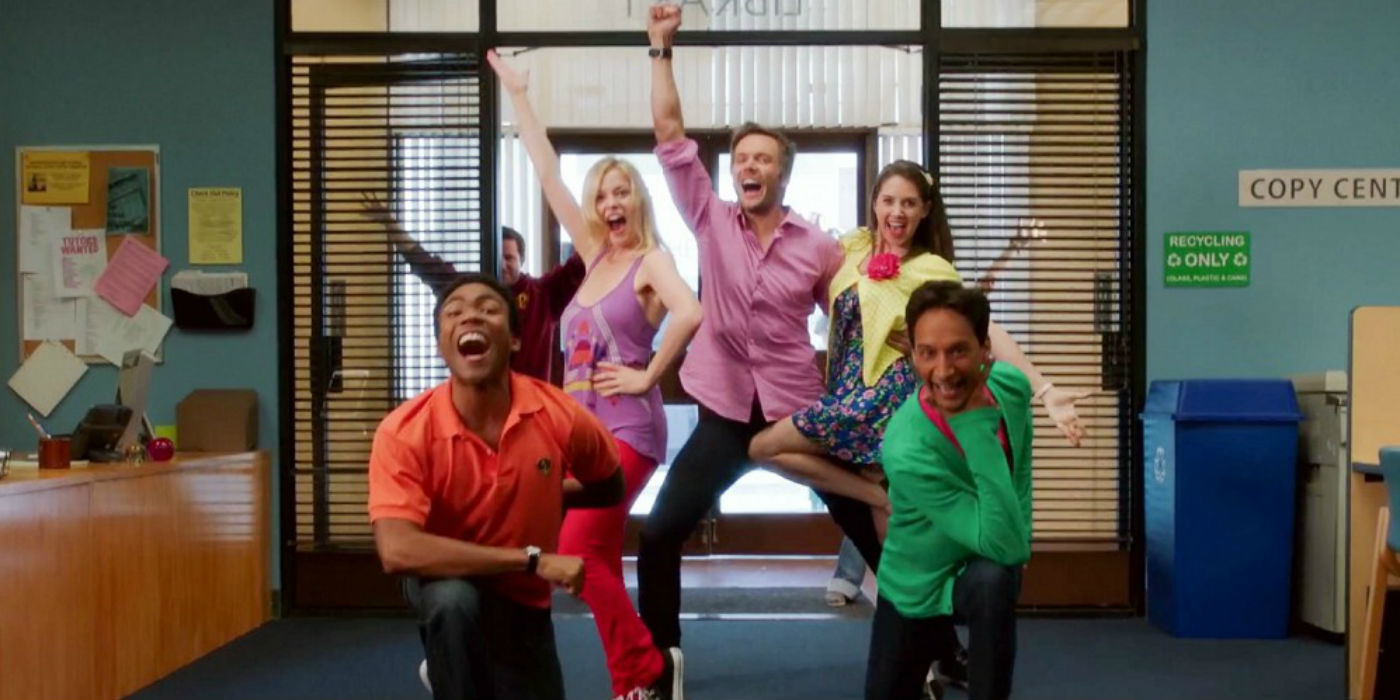
11. Community – "We're Gonna Be Fine"

Community ascended to cult status quickly – possibly faster than any other show on television – and became a beloved comedy classic before the end of its second season. Fans came for the detailed parodies and hilarious performances, but most stuck around for the genuine emotion that ran through every moment of the show's six-season run (except season four, according to most fans). Community was never one to shy away from a bold choice that mocked the show itself, which is exactly how the show opened up their third season.
Beginning with Jeff Winger flying through the clouds, the cast is led in a musical number about how "We're gonna get more calm and normal / We're gonna fix our state of mind / We're gonna be less crazy / We're gonna finally be fine." The dream itself works on two levels, as most things in Community do. Within the show, it's representative of Jeff's wishes to just have a normal community college experience void of the sadness masked in wacky antics that are Greendale's trademark. On a metatextual level, it's poking fun at the series poor ratings and how difficult it is to get a "mainstream" audience engaged in the show. It may not be mainstream, but plenty of fans love Community exactly for that reason.
10. BoJack Horseman's Bad Trip

BoJack Horseman surprised everyone. The show itself seemed to be nothing more than Netflix's foray into a typical "adult comedy" like those found on Comedy Central, and initial reviews for the show were mixed at best. The first season of BoJack Horseman has a 59% on Metacritic, a far cry from season two's score of 90%. It seems most critics didn't make it to the end of the first season, when the show finally revealed what it actually was. As the first season unfolded, Bojack Horseman's exploration of mental illness was revealed piece by piece, before the show went all out by throwing Bojack into psychedelic drug trip.
What begins with a simple misunderstanding between brooms and guns turns into a full-fledged horror show as BoJack's ghostwriter undergoes a body horror-inspired transformation rivaling Akira and David Cronenberg's best grotesquesqueries. Then BoJack's entire world begins to fall apart – he is literally losing the lines that give his animated body definition. After running through a flurry of horrors, including animated sequences inspired by the works of Charles Schultz and Don Hertzfeld, the sequence finally gives BoJack a chance to live a happy life. His dream ends with him living in a cabin on the lake with his long-lost love Charlotte, raising a child and growing old together. This brief moment of peace ends when BoJack wakes up in a parking lot, searching for Diane to ask her to assure him that he is a good person. This bad trip marks the moment that BoJack Horseman proved it could be more than just funny.
9. Six Feet Under - "Ecotone"

Nas once said, "I never sleep, cause sleep is the cousin of death." No television series explored this relationship more than Six Feet Under, a series that relied frequently on dream sequences to help the characters maneuver their internal conflicts. The show itself explored the effect that dealing with death on a daily basis must have on a family, but most of those deaths were of tertiary importance, at best. So how does a show defined by death treat the death of its main character? With a dream sequence, of course.
While most shows would wait until the series finale to kill off their main character, Six Feet Under bit the bullet a few episodes prior to the series end, showing Nate's final thoughts – or are they David's? Nate, asleep on a hospital bed, suddenly wakes up in his own home before being summoned outside to hop into a van with his brother – now in full stoner mode – and smoke weed while their long-deceased father drives them to the beach. As Nate runs into the ocean, David is suddenly not his stoner-self, but the suit-and-tie, clean-shaven David that the audience is familiar with, yearning for Nate not to run into the ocean. Nate falls into the ocean and David awakens with a fright – looking over from his (possibly shared) dream to discover that his brother had passed away. It's a truly touching moment between the two brothers whose relationship defined the series, connecting in the dream world for a brief moment.
8. Hannibal - "Primavera"

It's a miracle that Hannibal ended up on television, let alone a network like NBC – and for three seasons, no less! The most beautifully grotesque show to ever air on television never shied away from showing the monstrous side of humanity, often manifesting it through bloody, macabre imagery. While other shows save their most terrifying imagery for nightmare sequences, all of Hannibal felt like a nightmare and the most gruesome images would often happen within the reality of the show. One dream sequence, however, rivals even the most disgusting crime scenes featured in reality.
The sequence shows Will Graham inspecting what appears to be a crime scene – a body that has been beheaded, de-appendaged, and folded upon itself to resemble a human heart, which is frankly just par for the course when it comes to disturbing Hannibal crime scenes. But things take a turn for the "Nope!" when this body starts unfolding, sprouting hooves out of its limbs, and growing antler horns to resemble The Stag that has haunted Will Graham since the beginning of the series. As if that wasn't enough, the body-stag begins creeping toward Will and almost gets to him before he, thankfully, wakes up. Sequences like this prove that Hannibal is a show whose nightmare sequences may actually cause nightmares.