Fringe was the kind of show that doesn’t exist anymore—strange, ambitious, yet patient enough to play the long game of procedural network television. Premiering in 2008, it followed Agent Olivia Dunham, scientist Walter Bishop, and his son Peter as they investigated the edges of modern science for the FBI’s Fringe Division.
What started as one of the best monster-of-the-week horror shows slowly unraveled into a story about loss, memory, and the limits of reason. The show’s science fiction was rooted in universal storytelling, where every experiment was carried out by people trying to fix what life had already taken.
That blend of invention and empathy made Fringe feel distinct even in its era. It was mysterious as far as shows like Lost go, and had the structure of The X-Files, but it carried itself with more sincerity. And its storytelling asked for the same stamina it gave; a demanding 20+ episodes per season. Fringe demanded investment, and it earned it by making every anomaly feel human.
Fringe Was The Ultimate Episodic Sci-Fi TV Show Of The 21st Century
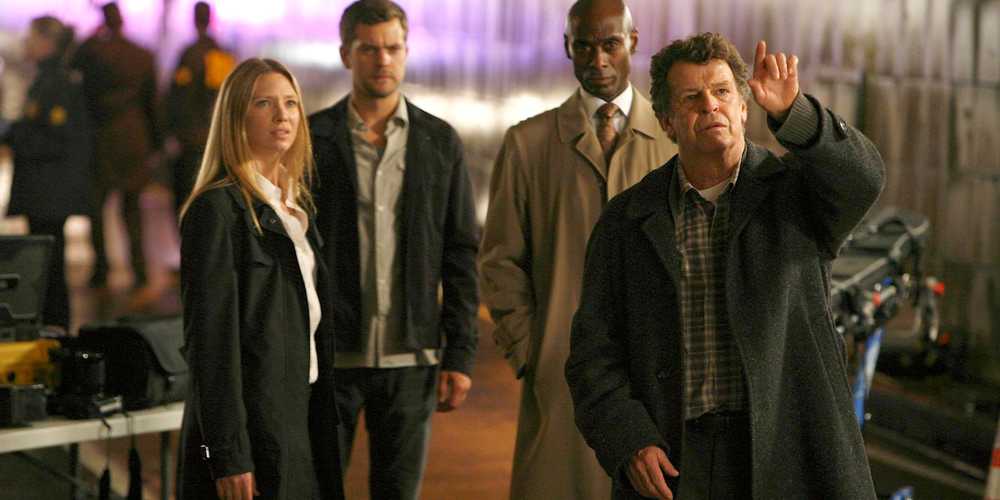
Every week, Fringe opened with something impossible, like a plane full of crystallized corpses, a man aging decades in minutes, or a city caught between universes, and it thrived on that structure. The cases were bizarre, but the rhythm was deliberate, and within that rhythm, the show found room for emotion to surface in ways serialized dramas rarely allow.
Walter Bishop’s experiments carried the show’s moral gravity, where every discovery felt like restitution for what he’d done to his son, and every new case echoed the same guilt in different forms. Olivia Dunham’s composure gave those stories weight, frequently grounding the science in human cost, and she was always studying the consequences of hunting monsters.
Even Peter’s skepticism worked as a conscience for the show, reminding everyone that invention always comes with a debt. Together, they turned a government task force into a story about responsibility, of people trying to hold together what progress keeps breaking apart.
Fringe earned its place as one of the few sci-fi show masterpieces because it treated its own pattern like a character. The investigations, no matter how strange, always circled back to the same idea: that knowledge changes people, and not always for the better. Across Fringe’s best episodes, the show didn’t reinvent itself so much as refine its focus, proving that repetition can still evolve.
How Fringe Remained Exciting Despite A Repetitive Formula

Every episode of Fringe began the same way. There’s a death, a disturbance, a mystery that shouldn’t exist, and it ends with a deeply emotional moment you never saw coming. The show’s writers understood that the show's tension didn’t come from the anomaly itself, but from what it revealed about the people chasing it.
Every new investigation was a sentence in a larger conversation about guilt, forgiveness, and the limits of control. For example, Walter’s curiosity often doubled as self-inflicted punishment, his excitement undercut by the fear of repeating his worst mistake. And Olivia’s calm broke in small, deliberate ways—a tremor in her voice, or a look that lasted a second too long—reminders that empathy can’t stay hidden forever.
Even the so-called “monster” episodes were more aching than horrifying. In season 3 episode 9, “Marionette,” a grieving surgeon reconstructs the body of a dead ballerina, convinced he can bring her back to life, but realizes that he's merely revived an absence in his life. The story plays like a classic science fiction episode until its final scene, when Olivia confronts Peter about his relationship with her double from an alternate universe.
Then, in season 2, episode 18, “White Tulip,” a physicist’s attempt to time travel and undo a personal tragedy forces Walter to confront his own stolen miracle: Peter. The episode ends as a simple symbol of forgiveness that lands harder than any twist. Moments like these made Fringe’s formula feel infinite. The science was always the setup, and the emotion was the true reveal.
That balance of predictability and depth kept Fringe never had a bad season and was alive longer than most network dramas of its kind. Under the procedural formula, the audience learned to anticipate the shape of an episode, not for a new surprise, but for the variation. Fringe trusted its viewers to listen closely, to hear the difference between the same notes played with new feeling.
We Don't Get Shows Like Fringe Anymore

Fringe ran for five seasons on Fox, each one built around 22 episodes that allowed for detours, experiments, and slow emotional build. This was a time when network television production was demanding (and the network shows of today still are!), but also gave stories room to breathe. That rhythm gave its characters the space to falter and recover in real time.
These days, however, the short and excellent sci-fi TV shows you can binge in a day don't have the patience for that rhythm. The shift to 10-episode seasons and binge release schedules reshaped how stories are told, through compressed arcs, hour-long episodes, higher budgets, and smaller scope. Unless you’re a rare phenomenon—a show like Stranger Things—then television moves faster but feels thinner, designed to be consumed rather than savored.
|
Season |
Total Episodes |
Rotten Tomatoes Score |
|
1 |
20 |
85% |
|
2 |
23 |
82% |
|
3 |
22 |
100% |
|
4 |
22 |
100% |
|
5 |
13 |
88% |
Fringe thrived on that endurance and its longevitiy came from the stretch between episodes, the repetition that made change visible. When a show could spend an entire week on grief or discovery, you felt it. Now those moments get edited down to fit the pacing of the new streaming format.
As much as I love shorter seasons, the algorithmic precision leaves little space for the tonal drift that Fringe and some of the best science fiction TV shows of all time used to thrive on. There’s no room for experimental episodes that dare to be strange, or tender, or even uneven.
Take Stranger Things season 2 episode 7, “The Lost Sister,” where the show uses Eleven to go on a detour. In the bottle episode, Eleven reunites with Kali, another child experimented on by Brenner. And during this journey, Eleven learns that, despite Kali’s advice, harnessing her powers through anger isn’t the right choice.
With only nine episodes in the season, using any episode as an experiment was a gamble that didn’t pay off for the Duffer Brothers; it’s the worst-rated episode in Stranger Things. Where Fringe trusted that an audience could handle inconsistency if the feeling underneath stayed true, Stranger Things' admirable leap of faith proved that kind of faith doesn’t exist in the modern system.
Should Fringe Get A Reboot?

A reboot of Fringe would be easy to imagine; the concept fits almost too neatly into today’s serialized model. With its overlapping universes and slow-burn mythology, it could thrive as a tightly focused mystery on a streaming platform.
That version would be cool in its own way, sure, as a sleeker translation of a story built around aliens and monsters. But it would also lose something essential: the looseness, the tonal detours, and the playful messiness that came from its procedural format. Fringe needed that room to breathe, to stumble, to find its emotion between the cases.
If the show were to return, it would do best to return as it was—weekly, uneven, and alive on Fox. The imperfections of that format gave it its warmth. Rewatching now, Fringe remains a reminder that science fiction works best when it’s allowed to stretch, to contradict itself, to feel handmade.


Fringe
- Release Date
- 2008 - 2013-00-00
- Network
- FOX
- Showrunner
- Jeff Pinkner
- Directors
- Brad Anderson, Fred Toye, Jeannot Szwarc, Charles Beeson, Akiva Goldsman, David Straiton, Dennis Smith, Jeffrey G. Hunt, Paul A. Edwards, Paul Holahan, Thomas Yatsko, J.H. Wyman, Jon Cassar, Miguel Sapochnik, P.J. Pesce, Adam Davidson, Anthony Hemingway, Bill Eagles, Bobby Roth, Bryan Spicer, Christopher Misiano, Chuck Russell, David Moxness, David Solomon
- Writers
- Graham Roland, Alison Schapker, Josh Singer, David Fury, Monica Owusu-Breen, David Wilcox, J.R. Orci, David H. Goodman, Glen Whitman, Robert Chiappetta, Ashley Miller, Zack Stentz, Zack Whedon, Julia Cho, Matt Pitts, Ethan Gross, Jeff Vlaming, Jason Cahill, Felicia D. Henderson, Justin Doble, Nora Zuckerman, Christine Lavaf, Lilla Zuckerman