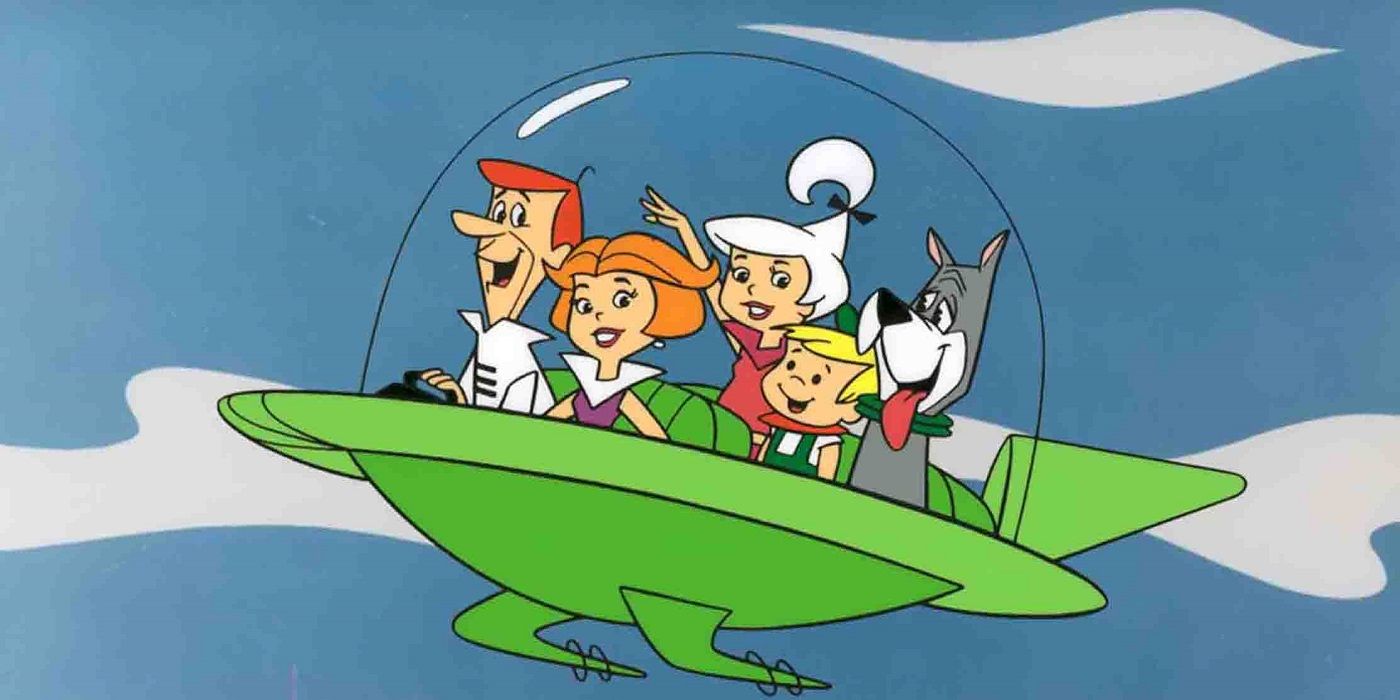
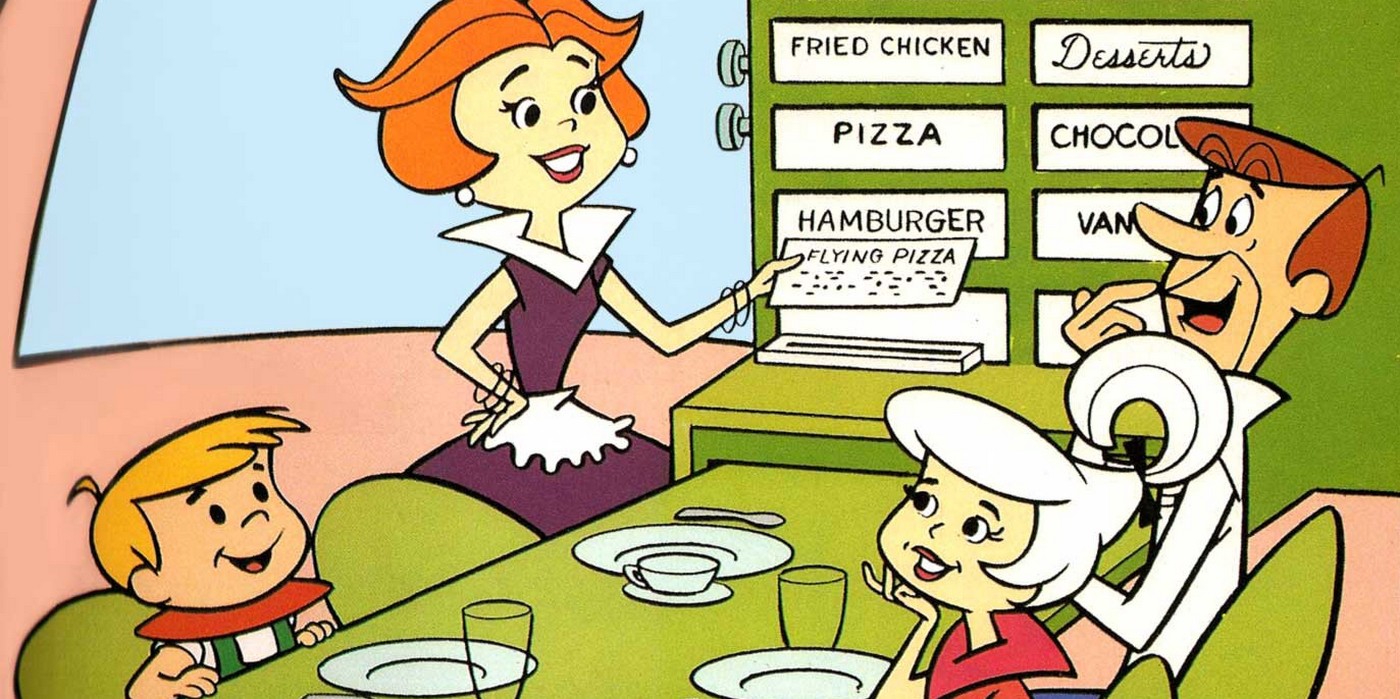
The Jetsons debuted in 1962 and, although the cartoon has held onto incredible cultural relevance, it originally only ran for 24 episodes in one season. Those episodes were replayed again and again for decades until Hanna-Barbera made more episodes in the mid 80s and, eventually, one movie.
In the early 60s, Americans were looking to the future with more optimism than ever, as the war had ended long before and the 50s had been a decade of growth, both for the economy and national patriotism. These favorable circumstances, crossed with the explosion of the television medium, brought more channels, more programming, and more images directly into people's living rooms. JFK would announce his famous moonshot alongside The Jetsons on that television. A generation of young people grew up on this show and its reruns, thinking about the future. The Jetsons family were the Buzz Lightyear of its era.
Considering that level of influence, it’s important to point out some times the show crossed the line and fell prey to the prejudice of its time. Here are 15 Inappropriate Moments Everyone Forgot About In The Jetsons
An Episode The Says We Should All Be Taught By Robots

In the future of The Jetsons, everything is automated, but modernization can go too far. In this episode, "Elroy's Mob", they explore the idea of a robotic teacher 'Ms. Brainmacher'.
This ends up in a, sometimes funny, but mostly pretty dark depiction of how teachers and the education system was viewed at the time.
The mass production of educated young people has been a concern around the world since the beginning of the collective society. This episode feeds into the dangerous idea that the most effective public education will be streamlined and evaluated into maximum efficiency. As complicated as learning is and as unique as each student is, teachers are the last occupation that should be turned over to the robots.
The episode glancingly alludes to the problem when Elroy’s grades are sabotaged by a classmate, as Ms. Brainmacher is easily fooled by a clever malcontent. After Elroy runs away from home, the mix up is resolved, but every day after that, he needs to go to school for days of monotonous learning, never having a teacher in his life that could actually inspire him.
No People of Color In the Future

Throughout the entire twenty-four episode run of The Jetsons, not one character of color was deemed worthy of incorporation into this “idealized” future. Watching it today, that’s probably the thing that sticks out the most about the show. Especially considering how vibrant the rest of the show is, so much of the animation focuses on bright, primary colors, maybe that had something to do with making all the white people stand out even more.
The first inclination is to say, sure it was a different time, but really it was a time when this would have been even more politically striking.
This season came out in 1962, right in the middle of Kennedy’s presidency. Maybe the Civil Rights movement wasn’t technically at its peak, but it was definitely on the radar of American culture. For a kids television show to focus on the future and ignore every one of those issues is pretty irresponsible. Consequences are especially troubling now, looking back at the generation of kids who grew up learning that the future didn’t have to include people of color or allow for alternate power balances.
Recurring Offensive Jokes

At least they’re equal opportunists with the jabs that the Jetson family, usually George, takes at other cultures and nations. Stereotypes are exploited to the utmost, usually at the expense of Russians, Chinese, and Africans. It’s no mystery where these jokes come from, obviously this show was produced at a time when the true insidiousness of prejudice was poorly understood.
From a writing standpoint, these jokes are always used as filler, indicating lazy pleas for cheap laughs; precisely the kind of tactics that age poorly.
From a children’s cartoon standpoint and a cultural zeitgeist perspective, the impact here is most troubling. The power of this show isn’t only academic now, it was a huge success at the time and has been referenced and endured through all these years as a building block. The fact that it influences culture by also promoting those immature attitudes and defense mechanisms is disheartening. One watches these episodes and those moments, now, looking back with a sense of “oh, that’s one of the exact moments when we began to drive the car off the road.”
Teenage Judy Getting Hit On By Her Dad’s Boss

The Cosmo Spacely character, George’s boss, struggles to ever come into his own on screen. He’s written as nothing more than a bully and power hungry boss, but one that tells a lot of jokes and fills up the laugh track. The creepiest part of his character is the handful of times he hits on Judy Jetson when he comes over to the house.
Repeated comments about her beauty and development cross way over the line for a kids TV show.
Judy’s character arc is heavily sidelined throughout the series, reiterating the theme of the show being written specifically for young boys, not making any effort to appeal to young girls watching the show who might be curious about the future. Further, in the scenes where Mr. Spacely does stroll on the screen and spew sleaze at Judy, all the little girls watching at home will see that if that happens to them, with their dad’s boss, it’s behavior that’s acceptable and institutionalized in the culture.
An Episode About Women Being Bad Drivers

The flying cars are an innovative, inseparable piece of The Jetsons, but they also factor in a lot more than one would think throughout the series. No matter how nice the cars get, there’s always way too much traffic, Perfect for jokes, and ironic, considering how much open sky there seems to be. The 18th episode of the season, “Jane’s Driving Lesson” takes the trope a little too far and leans on it to make a premise solely dedicated to how women can’t drive, and how crazy and stressful that is for George.
The episode opens with George having a particularly stressful day and a horrible haircut. He then proceeds to depict him having a shouting match and decrying women drivers as overtly and loudly as possible with the aid of an car mounted intercom.
This episode continues taking great pains to paint George as the woeful, over-burdened patriarch, and he gets one more nuisance: Jane wants to learn to drive.
Every man, not just George, but everyone at her driving school, recoils in fear at the notion of a woman trying to learn to drive. Watching it now, one is constantly expecting the parody to turn around and reward Jane in the end. She gets her license, but the episode doesn’t earn it, instead opting for a pretty cowardly story of men afraid to face women behind the wheel.
An Episode of Humans and Robots at War

The 1960s was a decade in the thick of robot philosophical thought. For the first time, electronics were developing to the point where they drove the imagination to infinite possibilities. Machines were finally developing personalities along with enhanced abilities. This led the tone of all science fiction of the time to shift toward an exploration of the relationship between man and machine, a dynamic that had always existed, but never held the true weight of that term “relationship” before.
Episode 215, “Robot’s Revenge” explores one of the ways that relationship can go wrong.
A robot working at a spa gets fired when George Jetson complains about his massage technique; the robot snaps and launches a vicious vendetta against Jetson.
Feasible premise aside, it’s hard to identify the message of this episode. The evil robot is never redeemed, instead he communicates with all his robot friends to help exact vengeance. Kids sitting at home are left with the troubling message: be nice to robots because they’re far more powerful than you.
An Episode Romanticizing Stereotyped Husband-Wife Roles

Early in the first season of the show, they ironically rely on the more archaic tropes of sitcom humor. Episode 103, “The Space Car” is a deep dive into the relationship between George and Jane Jetson. Kudos to the show for trying to depict adult relationships, but mostly shame on them for slumping down into one liners fueled mostly by gender stereotypes and paternalistic woe.
The couple is dissected through a comparison with arch criminal couple, Knuckles Nuclear and his Bonnie and Clyde partner. The Jetsons get their car mixed up (probably due to a faulty robot) and drive away in the robbers’ getaway car. The episode attempts to show that husband-wife relationships are beautiful, even if they’re both criminals. Love conquers all.
Unfortunately for the kids at home, every other scene is peppered with jokes about how inept Jane is at anything outside of the home.
It also looks at how their relationship revolves around the men’s decision, and both husbands decrying their intolerable mothers-in-law. Not a promising template.
An Episode That Mishandles Intellectual Property

Episode 107, “The Flying Suit”, explores the relationship between innovation and capitalism, but it offers a sad view of the every man’s connection to the economy at large.
George is caught in the middle of both Mr. Spacely and Mr. Cogswell, his boss and his rival, thanks to a tragic mishap.
Once Cogswell invents a flying suit suit, George stumbles upon it via a dry cleaning mistake. An experiment of Elroy’s convinces George he invented the suit with the ability to fly. After George tries to turn in Cogswell’s work first as his sons, and then as his own, the whole situation blows up in his face and he fails to get his cherished vice presidency. Maybe this episode is trying to make the argument that there are no shortcuts to success, but that message is impossible to hear through George’s whining and ignobility.
No Stories That Don’t Congratulate White American Pop Futurism

If science fiction is trying to explore possibility and the unknown, not only what could be, but what will be, eventually, then this show is pretty limited in the themes it explores and decides to expand on. The most striking elements of the cartoon are the cartooning: the colors, the shapes, the art and architecture of the future.
A fair amount of energy is also devoted, throughout all 24 of those original episodes, to exploring the industrialization and automation of the processes of the future. The ease and expected comfort of that future is promoted in every episode. In that way, the series is very optimistic, especially about the American industrial complex and the growth of the middle class.
The depressing part, especially considering the power and influence this show holds, is a lack of optimism for humanity in any other regard.
The family dynamics and philosophical/ethical tensions are always written the same as in other shows, almost deliberately as if to say that in the future, all of our internal problems will remain the same, but everything external will be smoother and shinier. Not an uplifting definition of progress.
An Episode That Accidentally Glorifies Las Vegas

Already a Saturday morning cartoon is on shaky ground for even attempting a Las Vegas episode. Rewatching cartoons as an adult often leads one to question the motives of the animator and this episode is no exception, leading one to wonder whether an eventful weekend influenced this story. In “Las Venus”, George and Jane drop the kids off with their grandparents and take a second honeymoon to relax and unwind. Naturally, they even get a speeding ticket driving into the lunar city.
The Jetson parents zoom past the “Flamoongo” to their hotel, the “Supersonic Sands”, and the jokes continue to flow as kids at home are getting a cartoon-ified look at what boring vacations parents are supposedly having when they’re on their own.
An opportunity to present a mature version of adulthood is squandered here, depicted more as a pursuit of glamour and a futile escape from the monotony of everyday life.
George’s work interferes in his life yet again, taking up all of his time so he can’t even enjoy his vacation. The necessity of rest and recuperation is an important lesson for a Saturday morning cartoon, but setting industrial grunt work and Las Vegas as the two opposites doesn’t give the future enough credit.