Few movies have created as much hype as next year's The Dark Tower. After years stuck in development hell, the film is finally shooting. With each set photo pitching the fan's excitement higher and higher, it can be hard to remember that The Dark Tower has never exactly been easy for the newcomer to get into. Stephen King's signature series is sprawlingly rich and very strange. It blends genres together at will, including horror, western, high fantasy and science fiction. It's filled with intense violence and disturbing sequences that don't exactly make it an easy pitch to the studios. It has a dense mythology and a sprawling cast of hundreds of characters, many of whom will cross over from other books.
So here are the 15 Things You Need To Know About The Dark Tower.
15. It's Not A Universe It's A Multiverse

It's currently pretty popular to refer to fictional worlds as universes. The Marvel Cinematic Universe, the Tarantinoverse, the Star Wars universe, etc. It's a good term, neat and concise, but for the world of The Dark Tower it just won't do (after all, precious little in The Dark Tower is neat and even less is concise).
The whole idea of The Dark Tower is that, of a sprawling multiverse, there is a whole slew of alternate universes, worlds packed upon worlds packed upon worlds. The central character, Roland The Gunslinger, the last member of a destroyed civilization, is journeying through them trying to find The Dark Tower. Most of these universes, like the one our hero Roland comes from, are wracked with entropy, falling apart and in chaos (referred to in the book as "Moving On"), a symptom of a sickness within The Tower itself, a sickness that Roland hopes to root out.
The Tower is something of a nebulous concept. It's both the lynchpin of reality, holding these worlds together, and bigger than reality, containing them all within itself. It helps to remember that The Dark Tower, for all its other influences, is very much a product of '60s hippy-dippy New Age thinking. It helps to think COSMIC. Because if a tower that simultaneously contains and exists in all realities sounds strange to you, buckle up, it only gets weirder from here.
14. It's Been Going On A Long, Long Time

Stephen King has been telling the story of The Dark Tower for 38 years and that's if you're being conservative. That was when the first chapter of The Gunslinger was published in The Magazine Of Fantasy & Science Fiction's October 1978 issue. Four more segments were published, then bundled together and released as The Gunslinger in 1982.
But according to King, he'd been telling the story to himself for at least eight years before that. King writes about its beginnings in quasi-mythic terms in the afterword to the 1982 edition of The Gunslinger.
"The Dark Tower began, I think, because I inherited a ream of paper in the spring semester of my senior year in college. It wasn't a ream of your ordinary garden-variety bond paper, not even a ream of those colorful "second sheets" that many struggling writers use because those reams of colored sheets (often with large chunks of undissolved wood floating in them) are three or four dollars cheaper. The ream of paper I inherited was bright green, nearly as thick as cardboard, and of an extremely eccentric size-[...] During that spring semester, a sort of hush fell over my previously busy creative life- not a writer's block, but a sense that it was time to stop goofing around with a pick and shovel and get behind the controls of one big great God a'mighty steamshovel, a sense that it was time to try and dig something big out of the sand, even if the effort turned out to be an abysmal failure.
"And so one night in March of 1970, I found myself sitting at my old office-model Underwood with the chipped 'm' and the flying capital 'O' and writing the words that began this story: 'The man in black fled across the desert and the gunslinger followed.'"
13. It Has Some Unexpected Ancestry

One of the biggest precursors to The Dark Tower is "Childe Roland To The Dark Tower Came" a poem by 19th-century romantic poet Robert Browning. Those looking for a direct plot summary encoded in "Childe Roland" might walk away confused and frustrated. It's an odd poem, one third narrative, one third tone poem and one third modernist hellscape a hundred years ahead of its time. People have spilled a lot of ink trying to unpack it.
The title itself is drawn from a nonsense stanza in King Lear and trying to glean much more meaning from it than that is asking for trouble. King himself termed the poem, "gorgeous and rich and inexplicable." It should also be noted that another famous interpretation of the poem provided by Margaret Atwood suggests that the poem is about a fictional creation meeting its maker, which, given the way certain plot lines develop in The Dark Tower, is certainly an interesting point to consider.
Whatever else King drew from "Childe Roland To The Dark Tower Came", he certainly took the names of characters, the central image of a lone figure crossing a desolate plain towards a looming dark tower, as well as the image of the figure reaching a horn to his lips when arriving there, which has proved surprisingly crucial.
12. As Well As Some Expected Ancestry

Like approximately 99% of post-1954 fantasy, The Dark Tower was inspired by The Lord of the Rings. In the essay, "On Being 19 (And A Few Other Things)" King talks about wanting to create a specifically American version of Lord of the Rings,
"They were the adventures of an essentially British band of pilgrims set against a backdrop of vaguely Norse mythology. I liked the idea of the quest- loved it, in fact-but I had no interest in either Tolkien's sturdy peasant characters (that's not to say I didn't like them, because I did) or his bosky Scandinavian settings. If I tried going in that direction, I'd get it all wrong."
The direction King would go in was provided by a work equally iconic, Sergio Leone's The Good, the Bad and the Ugly. From the same essay,
"I realized what I wanted to write was a novel that contained Tolkien's sense of quest and magic but set against Leone's almost absurdly majestic Western backdrop. If you've only seen this gonzo Western on your television screen, you don't understand what I'm talking about- cry your pardon, but it's true. On a movie screen, projected through the correct Panavision lenses, TG, TB & TU is an epic to rival Ben-Hur. Clint Eastwood appears roughly eighteen feet tall, with each wiry jut of stubble on his cheeks looking roughly the size of a young redwood tree. The grooves bracketing Lee Van Cleef's mouth are as deep as canyons, and there could be a thinny (see Wizard And Glass) at the bottom of each one. The desert settings appear to stretch at least out as far as the orbit of the planet Neptune. And the barrel of each gun looks to be roughly as large as the Holland Tunnel. What I wanted even more than the setting was the feeling of epic apocalyptic size"
Well he certainly achieved it because...
11. It's Big

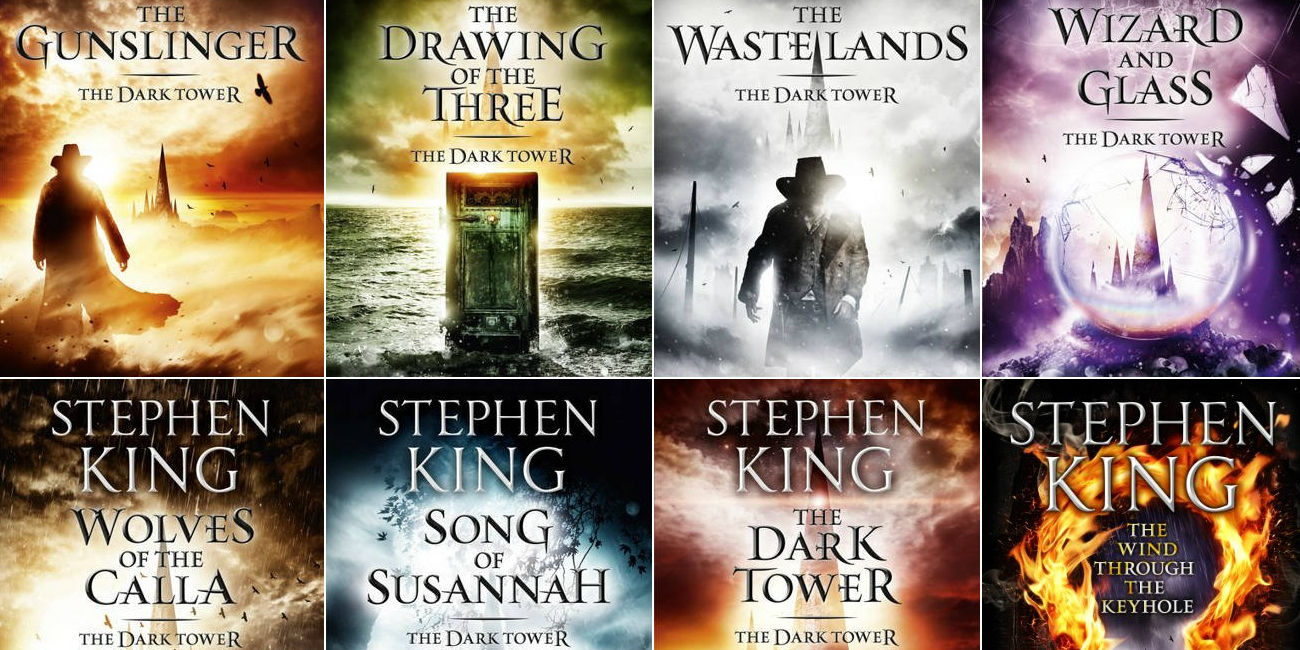
Like, really big. The core of the series runs eight volumes (you could actually argue for nine, but that's for another entry on the list): The Gunslinger, The Drawing of the Three, The Wasteland, Wizard and the Glass, The Wolves of Calla, The Song of Susannah, The Dark Tower and The Wind and the Keyhole. The collected series runs 4,250 pages and only God (or possibly Gan) knows how many words.
But wait! There's more. The series also includes the novella "The Little Sisters of Eluria," which can be found in the collection, Everything's Eventual, as well as various side stories that the comics introduced that are now considered canonical. King's world has become as sprawling and wild as the landscapes he so coveted in Leone's films. And with so many alleys and cul de sacs it's just so easy to get lost in...
10. No Seriously Really Big

Yes, The Dark Tower series is even bigger than that. The books referred to in the above entry are only those that center on Roland and his Ka-Tet. Gradually at first and then with growing determination, King has been tying the whole of his work into The Dark Tower. There are charts all over the internet showing all the various works intersect, like the nerdiest, most intricate game of six degrees of Kevin Bacon devised.
King makes it pretty easy. Even before he got really ambitious about it there have always been King novels where someone is driving by Castle Rock or Derry, for no other reason than to remind you that you're in Stephen King country. But even if you only take the works that directly connect to The Tower, that leaves you with an awful lot of books to go through. There are the novels Salem's Lot, The Stand, Insomnia, Black House, and Hearts In Atlantis just for starters, as well as novellas like "Ur" and short stories like "Everything Is Eventual."
As you may suspect that much work over so many years doesn't always hang together seamlessly, for example the characters who show up at the end of "Ur" espouse some mighty strange beliefs and act pretty benignly, considering who they supposedly serve, and there are continuity errors here that will drive world-building obsessed nerds up the wall. But that's part of the pleasure of The Dark Tower, it's serenely unconcerned with the prevailing trends in fantasy...
9. You May Already Know Some Of The Characters

One side effect of the series becoming so gargantuan is that even if you have never read a single word of the series it's possible that you still know some of the key characters in it. Characters like Father Callahan, the disgraced priest from Salem's Lot, and Ted Brautigan, the kindly psychic from Hearts In Atlantis, show up and play key roles in the final three books of the series.
The most famous Dark Tower character to cross the boundaries of fiction is The Man In Black, The Walking Dude, Randall Flagg himself. One of King's most iconic villains, Flagg is the first character mentioned in The Dark Tower series (hell he's the first four words). He's popped up in a lot of places over the years in King's fiction. It's hard to say exactly how many given his fondness for pseudonyms, but he's at least turned up in Eyes Of The Dragon, Hearts In Atlantis, and most famously The Stand, where he helps bring about the apocalypse. He's Roland's nemesis in the series, and remains one of its most fascinating and enigmatic characters.
8. Some Phrases You Should Know

Like any franchise worth its nerd salt, there's a whole vocabulary that's grown up around The Dark Tower. Sayings and phrases that are a bastard patois of King's signature New Englander speech, old west slang, and heightened Quasi-Arthurian English ("Do you ken?"). Most of these you don't need to know. They're the Stephen King equivalent of learning Klingon or Elvish. Knowing why it is proper behavior for you and your Ka-tet to spit on a guy's front yard if you happen to pass his hovel in the desert isn't really going to affect your enjoyment of the movie.
But some of it has surprisingly already cropped up in the film's advertising. Idris Elba, who will play Roland tweeted us all a reminder to "Remember the face of your father," a Mid World directive to keep your honor. And both King and Elba tweeted images of The Horn of Eld, a mystic totem, the equivalent of King Arthur's Excalibur, which holds great significance within the series, though just what that significance is we'll save for a little later in the list.
7. It's Taken A Few Twists Over The Years

It's impossible to separate The Dark Tower from Stephen King. The work has affected the author and the author the work. That is, of course, true of any writer and the things he writes, but King went so far as to eventually write himself into The Dark Tower universe and to make the accident that nearly killed him a central plot point.
For an author who is as famously, some might say notoriously, prolific as King, he wrote The Dark Tower at a veritable crawl. From The Gunslinger's debut in 1978 it took King nineteen years just to get up to book 4. King always had a somewhat antagonistic relationship with The Dark Tower, and in the afterword of the 1982 edition he grouses, "my brief synopsis of the action to follow suggests a length approaching 3000 pages, perhaps more...At the speed which the work entire has progressed so far, I would have to live approximately 300 years to complete the tale of the Tower."
Nine years later in the afterword for The Wasteland, volume three, the outlook was not looking much rosier, "finding the doors to Roland's world has never been easy for me and it takes more and more whittling to make each successive key fit each successive lock...it holds me in its thrall." Six years later we got one more entry, and then silence, a silence that almost became permanent when King was nearly killed by a reckless driver.
"I was with this good friend of mine when we heard you got popped," King remembers a fan telling him in "On Being Nineteen," "Man, we just started shaking our heads and saying, 'There goes the Tower, it's tilting, it's falling, ahhh, shit, he'll never finish it now.'" The thought obviously occurred to King as well. The first four Tower books were written at a crawl, the last three, all released within a year of each other, were written at a gallop.
How much did that affect the series? It's hard to say. Arguably The Wolves Of Calla ended up much as it would have, as King started to brainstorm it before the accident. But it certainly affected the other two. The accident is actually a set piece in The Dark Tower, creating a kind of action movie version of Pirandello, where the characters are put in danger by their author's potential demise and must prevent it.
Would the books be better if the accident never happened? It's impossible to say. They might never have come into being period. The Dark Tower in particular, has its flaws (don't even get us started on Susannah's ending) and it's hard not to think with the luxury of more time and few more drafts King might have produced something tighter and more dramatically satisfying. But the series is more than the sum of its flaws, and even with its fair amount of stumbles The Dark Tower has enough cumulative power to make the journey worth taking.
6. It's Been Second Guessed

Then again, if fans can't help but second guess King's world that's partially because King couldn't either. King actually rewrote the first volume of The Dark Tower, offering a revised version of The Gunslinger to readers just before the release of the last three books in the series. This version added 9,000 words and revised many small details, bringing the book more in line with the rest of the series (as mentioned given that the series was written over the course of 38 years, and careful world-building has never really been King's style, there's more than a bit of drift when it comes to the conception of Roland's world). King confided to Neil Gaiman that at one time he was considering rewriting all of the books, possibly excising his own appearance and the accident subplot from them, though that plan has since been abandoned.
Of course, the end of the series offers a different interpretation on the so-called revision, as does the subtitle that King inserts at the beginning of the new version . We'll keep things vague until the final entry, but for all we know it was just another spin of the wheel...